Action Potential Simulation
준비
MetaNeuron은 Hodgkin–Huxley model을 구현한 action potential simulation 프로그램이다. (저자: Univ. of Minnesota의 Eric. A. Newman)
- macOS 사용자 추가사항
Retina Display 사용시: MetaNeuron 아이콘 우클릭 → [정보 가져오기] → "낮은 해상도로 열기" 체크하기
"개발자를 확인할 수 없다" error 발생시: MetaNeuron 아이콘 우클릭 → 열기 → 열기
Resting Membrane Potential
MetaNeuron의 Lesson 메뉴 중 Resting Membrane Potential 선택
- Equilibrium Potential
세포 밖의 Na+ 농도가 100 mM, 세포 안의 Na+ 농도가 10 mM 일 때, Na+ 의 평형전압은 얼마인가?
세포 밖의 Na+ 농도가 10 mM, 세포 안의 Na+ 농도가 100 mM 일 때, Na+ 의 평형전압은 얼마인가?
세포 밖의 K+ 농도가 100 mM, 세포 안의 K+ 농도가 10 mM 일 때, K+ 의 평형전압은 얼마인가?
- 왜 그런가?
- Membrane Potential
[ Na+OUT, Na+IN, K+OUT, K+IN ] = [100, 10, 10, 100] mM 이고,
Na+ permeability = 1, K+ permeability = 100 일 때 Membrane Potential은?
Na+ permeability = 100, K+ permeability = 1 일 때 Membrane Potential은?
Na+-, K+ permeability를 조절해서 Membrane Potential = 0 mV 을 만들 수 있는가?
Axon Action Potential
MetaNeuron의 Lesson 메뉴 중 Axon Action Potential 선택
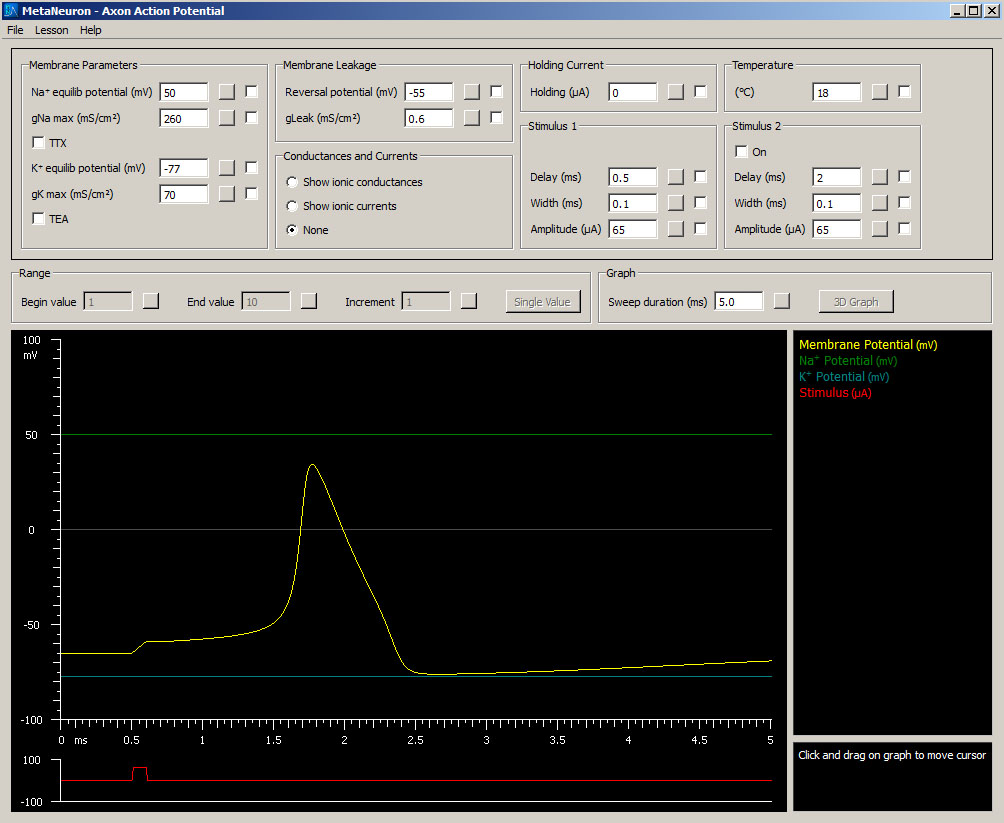
- Membrane parameter 설정
[ Na+-, K+- equilibrium potential ] = [ 50, -77 ] (기본값)
gNa, gK : Na+-, K+- 이온의 conductance (=permeability)
TTX: voltage-gated Na+ channel blocker (복어독)
TEA: voltage-gated K+ channel blocker (전갈독)
- Membrane Leakage
- Reversal potential: leak current의 방향이 바뀌는 membrane potential
gLeak (mS/cm2): leak conductance.
- Holding Current
- Holding (µA): background 전류. 보통의 경우 0 µA
- Stimulus
- Amplitude (µA): 자극(전류)의 크기
- Width (ms): 자극의 지속시간
- Delay (ms): 자극의 onset 전 delay
- Action Potential의 역치 관찰하기
- Membrane parameter를 기본값으로 설정한 상태에서 (메뉴 중 Restore Lesson to Default 실행)
- Stimulus 1의 Amplitude에 여러가지 값을 입력하여 역치를 관찰한다.
- Tip1: Amplitude (µA) 옆 box를 마우스로 드래그 (혹은 Ctrl-드래그)하여 amplitude 값을 바꿀 수 있다.
- Tip2: Amplitude (µA) 옆 옆 box를 클릭한 후, 아래 Range 입력 창을 이용하여 여러가지 range를 동시에 관찰할 수 있다.
- 역치는 얼마인가?
Action Potential vs. Na+ equilibrium potential
- Stimulus 값을 일정하게 유지한채로
Na+ equilibrium potential을 바꾸면서 Action Potential이 어떻게 바뀌는지 관찰한다.
- 왜 그런가?
Action Potential vs. Na+ conductance
Action potential은 voltage-gated Na+ channel이 몰려있는 axon hilock에서 발생한다.
Voltage-gated Na+ channel의 밀도가 낮은 곳은 gNa+ max 값이 낮을 것이다.
gNa+ max 값을 200~380 mS/cm2 구간에서 20 mS/cm2 스텝으로 바꾸면서 action potential 역치(µA)가 달라지는지 관찰한다.
gNa+ max vs. AP threshold graph를 그린다.
Action Potential vs. K+ conductance
- Stimulus 값을 일정하게 유지한채로
gK+ max 값을 바꾸면서 Action Potential이 어떻게 바뀌는지 관찰한다.
- Potassium ion의 conductance가 action potential에 어떤 영향을 미치는가? 왜 그런가?
Refractory Period
MetaNeuron의 Lesson 메뉴 중 Axon Action Potential 선택
- Graph 설정 패널의 Sweep duration을 10 ms 로 늘리고,
- Stimulus 1의 amplitude를 150 µA로 설정,
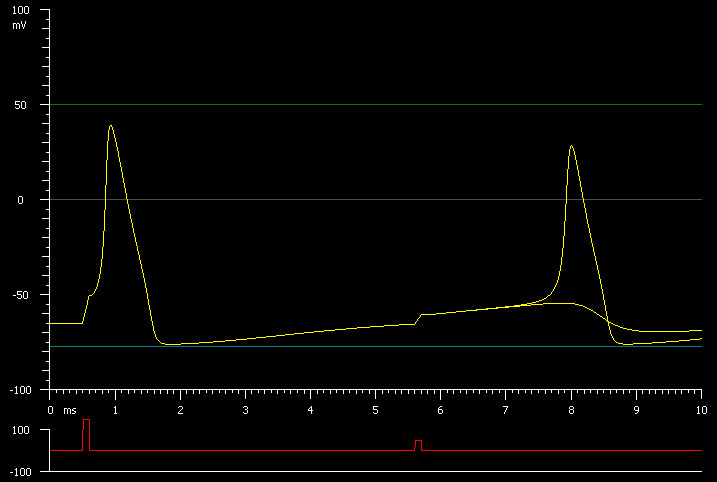
- Stimulus 2를 켜고, delay를 6 ms 로 설정하면 두번째 AP가 관찰된다.
- Stimulus 2의 amplitude를 줄이면서 두번째 AP의 역치를 찾는다.
- Stimulus 2의 delay를 5 ms 로 줄이면 AP가 사라진다. 이 때 amplitude를 늘려서 새로운 역치를 찾는다.
- Stimulus 2의 delay를 4 ms 로 줄이면 AP가 사라진다. 이 때 amplitude를 늘려서 새로운 역치를 찾는다.
- Stimulus 2의 delay를 계속 줄여서 1 ms 가 될 때까지 반복한다 (delay는 소수점도 입력가능하다.)
- Stimulus 2의 delay vs. threshold amplitude 그래프를 그리고, absolute refractory period와 relative refractory period를 구분한다.