Clustering
Classification vs. Clustering
분류 |
Learning 기법 |
요약 |
Classification |
Supervised |
기분류된 데이타로 회귀 모델을 만들어 분류 |
Clustering |
Un-supervised |
데이타 모양(거리)로 unbiased 분류 시도 |
Classification
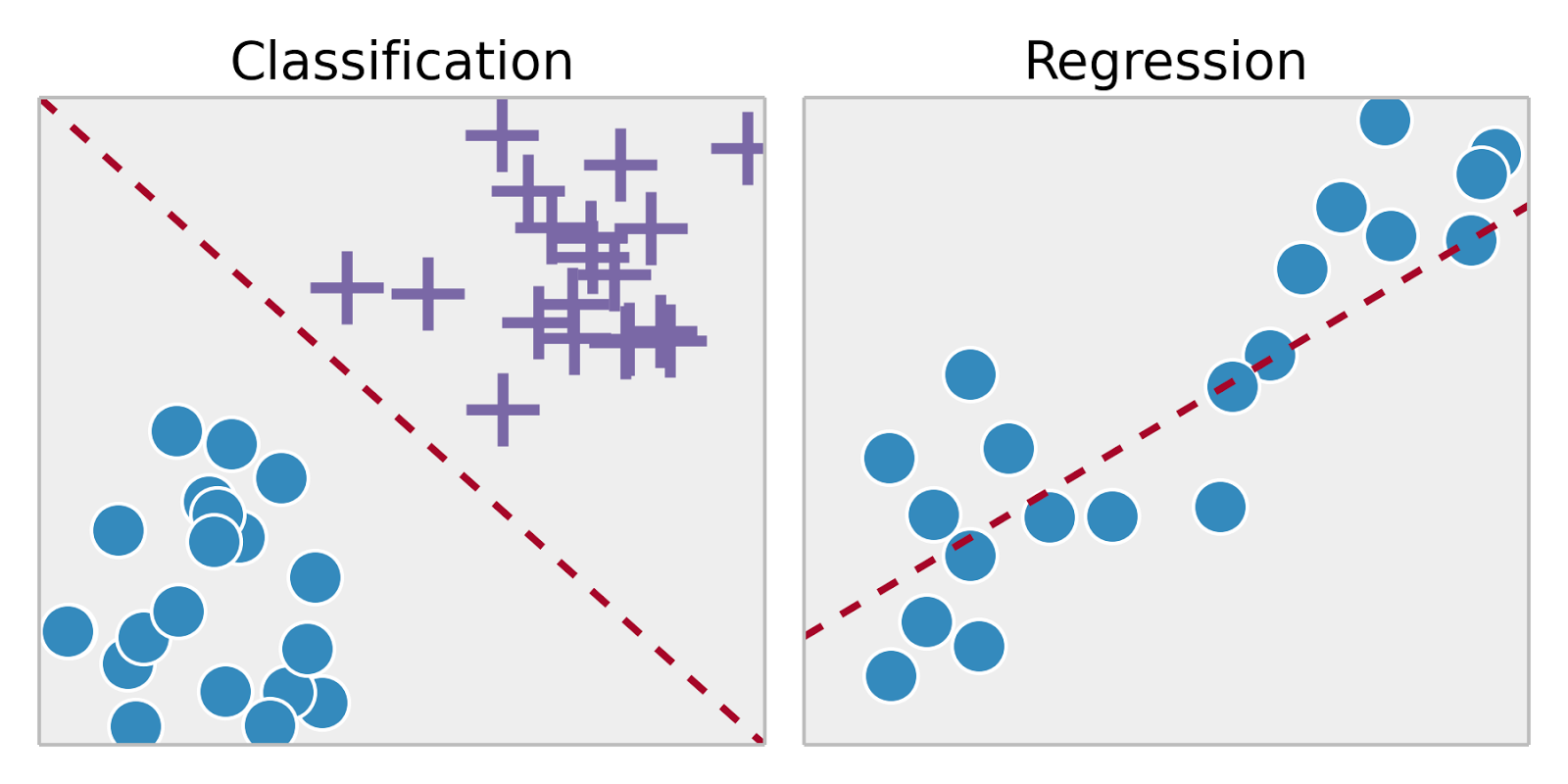
- Linear Regression을 응용한 logistic regression, naive bayes, support vector machines, artificial neural networks, random forests 등을 이용
- 기존 데이타(training dataset)으로 학습한 후 그 regression 함수로 새로운 데이타(test dataset)을 분류
Clustering

- training dataset이 없거나 구하기가 어려운 경우, 데이타 자체로 분류
- 한줄 요약: 거리가 가까운 데이터끼리 같은 그룹으로 분류한다.
거리 = sqrt(x12 + x22 + x32 + ... + xn2)
k-means Clustering

- 데이타를 k개로 분류하고자 한다면
- k개의 random point를 정하고 시작한다.
- 모든 데이타 점을 조사하여 k개의 point중 어느 것과 제일 가까운지 결정하여, 첫번째 분류를 완료한다.
- k개의 첫번째 분류에서 각 분류의 평균점을 구한다. 이 평균점을 새로운 k개의 point로 간주하고 위 과정을 반복한다.
- 더 이상 분류가 바뀌지 않으면 분류를 종료한다.
> str(fit)
List of 9
 $ cluster     : int [1:n] 5 2 1 5 4 5 5 3 1 1 ... (k개의 cluster)
 $ centers     : num [1:5, 1:2] 51.5 20.4 79.7 65.2 39.8 ... (각 cluster center의 x,y 좌표)
  ..- attr(*, "dimnames")=List of 2
  .. ..$ : chr [1:5] "1" "2" "3" "4" ...
  .. ..$ : NULL
 $ totss       : num 21631
 $ withinss    : num [1:5] 51.6 429.1 221.6 174.7 209.9
 $ tot.withinss: num 1087
 $ betweenss   : num 20544
 $ size        : int [1:5] 11 7 12 12 16
 $ iter        : int 2
 $ ifault      : int 0
Density-Based Spatial Clustering and Application with Noise (DBSCAN)
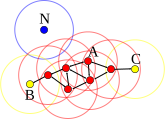
- 같은 그룹으로 묶고 싶은 최대 거리 ε과 같은 그룹을 형성할 수 있는 점의 최소 갯수 minPts를 정한다.
- 어떤 점 p의 거리 ε사이에 minPts개의 점이 있으면 일단 한 그룹을 만든다.
- 그 그룹의 모든 점의 ε 거리에 다른 점이 있으면 역시 같은 그룹으로 묶는다. (친구의 친구는 친구)
- 더 이상 확장이 안 될때까지 확장한다.
- 계산이 끝난 후에 아무 그룹에도 속하지 않은 점은 outlier(아싸) 처리한다.
> str(fit)
List of 3
 $ cluster: int [1:n] 1 2 3 1 3 1 1 3 3 3 ... (적절한 수의 cluster)
 $ eps    : num 우리가 입력한 값 저장됨 (참고용)
 $ minPts : num 우리가 입력한 값 저장됨 (참고용)
 - attr(*, "class")= chr [1:2] "dbscan_fast" "dbscan"
R 실습
data 읽어오기
ggplot2
R 기본 그래픽 함수 대신 편리한 ggplot2를 사용해보자.
형식: ggplot(data, aes(x=x_data, y=y_data, color=z_data)) + 다양한그림함수()
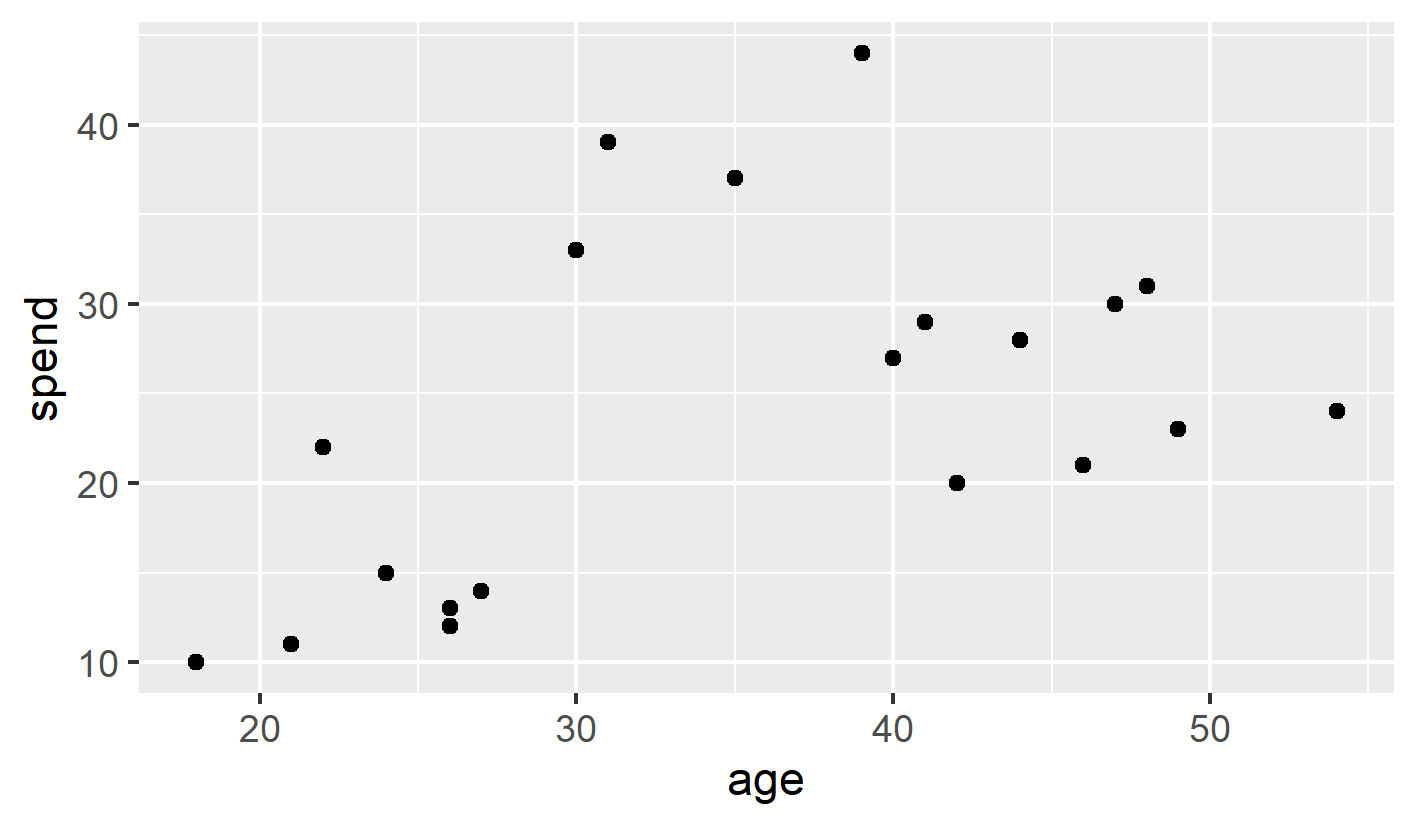
k-means clustering

- fit$cluster가 숫자 데이타로 인식되어 continuous coloring이 되어 버렸다.
- 이 값을 분류(factor) 데이타로 바꾼후 재시도하자.
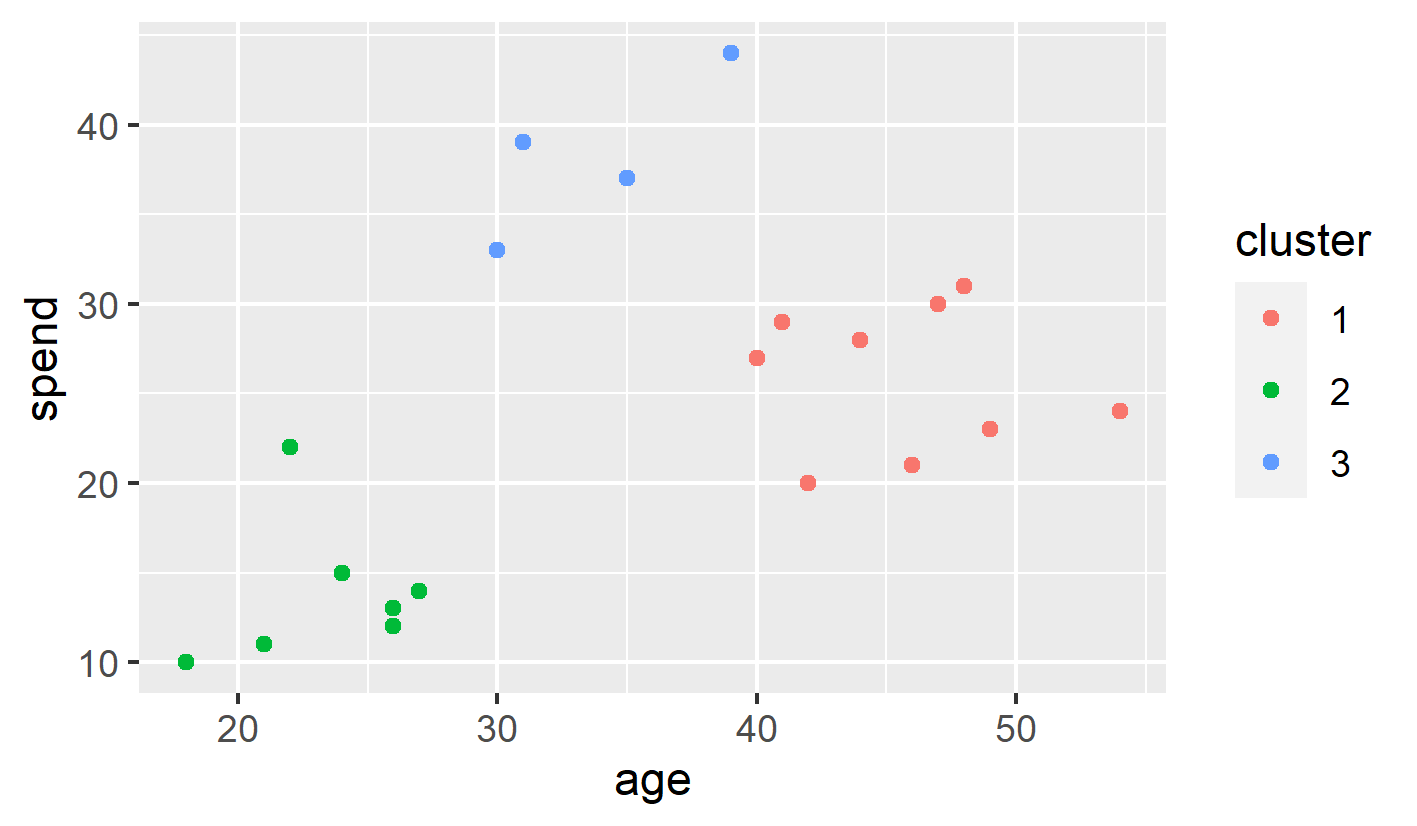
DBSCAN clustering
DBSCAN clustering은 dbscan 패키지로 실행할 수 있다.
- dbscan library를 불러들인 후, dbscan 함수를 사용한다.
- dbscan 함수의 인자로는 다음이 필요하다.
- 2D 행렬
- eps: 같은 군집으로 묶일 최대 거리)
- minPts: 같은 군집으로 묶일 최소 점의 갯수
실행하면 에러가 난다.
- Error in dbscan(df, eps = 10, minPts = 3) : x has to be a numeric matrix.
- 위 kmeans의 계산 결과로 df가 더 이상 2D 행렬이 아니게 됐기 때문이다.
> head(df)
  age spend cluster
1  18    10       1
2  21    11       1
3  22    22       1
4  24    15       1
5  26    12       1
6  26    13       1
해결방법: 다음과 같이 df의 1,2열만 사용한다고 명시한다.
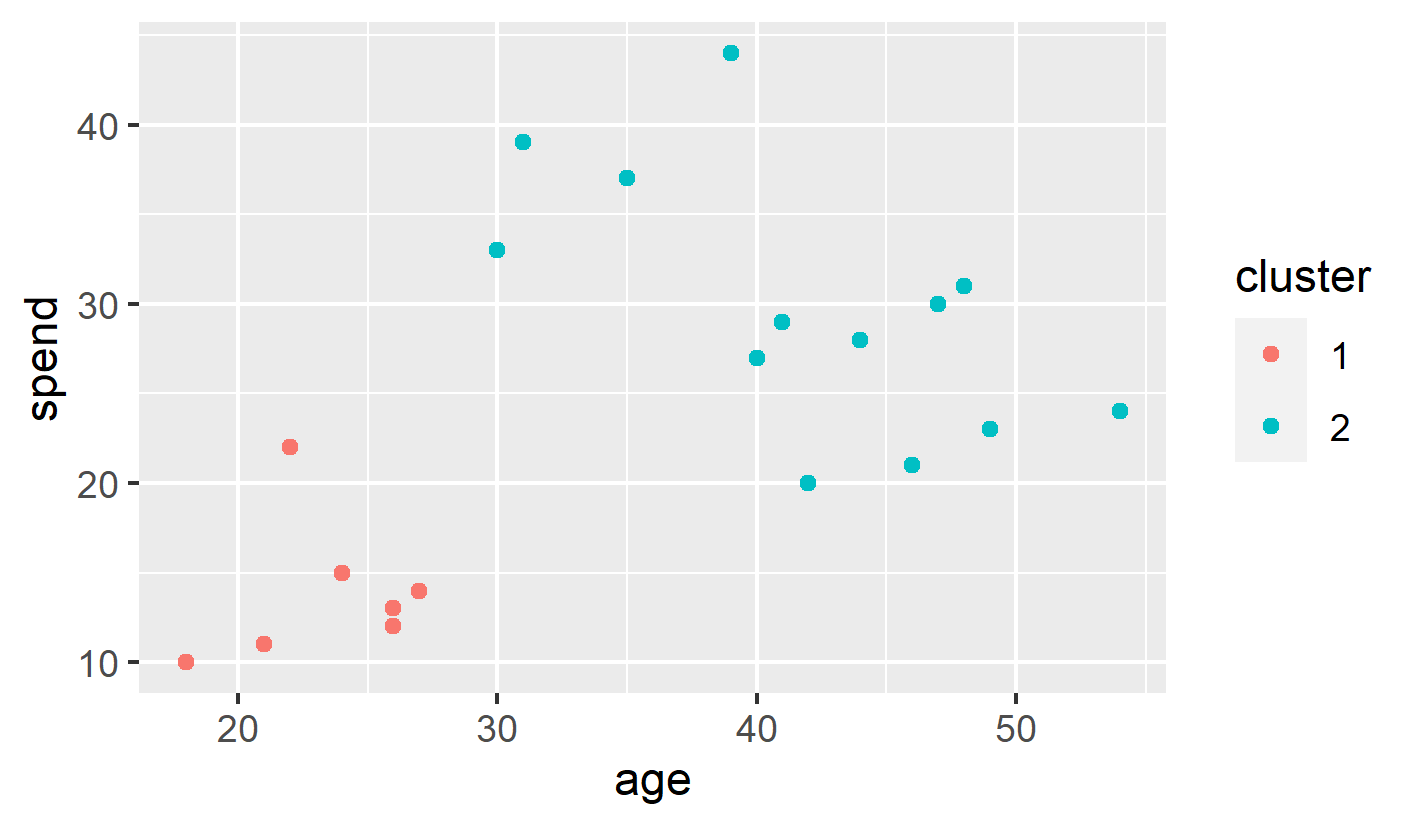
- 최대거리 10 이하를 한 군집으로 묶어준 경우 2개의 군집이 된다.
eps 옵션을 줄여보자.
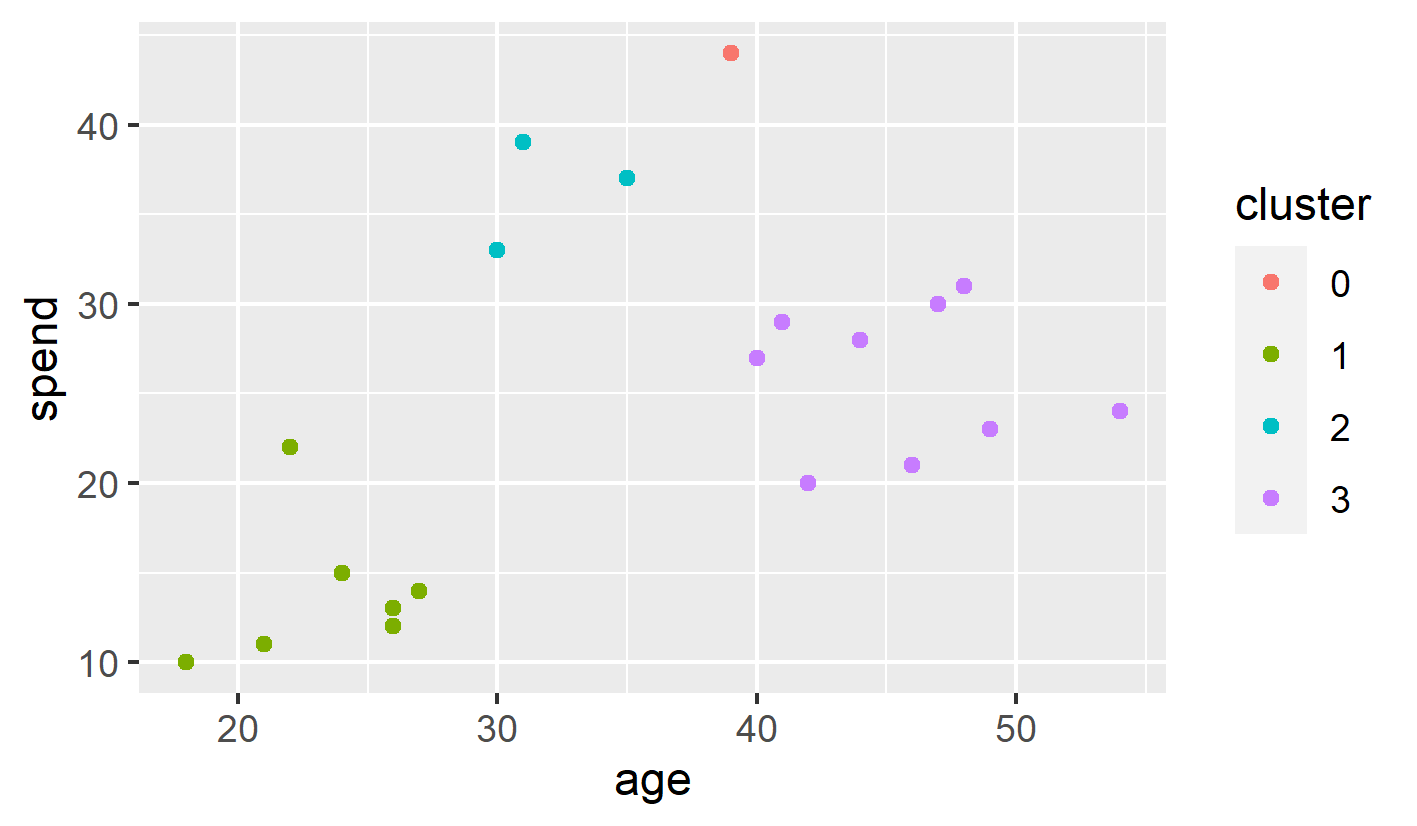
- cluster 0은 outlier다. (어느 점과도 eps 거리 안에 속하지 못 함)
과제: MASS Library의 Pima.te 데이터를 이용하여 age vs. bmi 그래프를 그리고, 이를 5개의 군집으로 나눠서 색칠하세요.
코드 시작:
library(MASS)
data(Pima.te)
df <- Pima.te[,c(7,5)]